NEMA 14-50 vs 6-50: The Neutral Is the Only Real Difference
Published
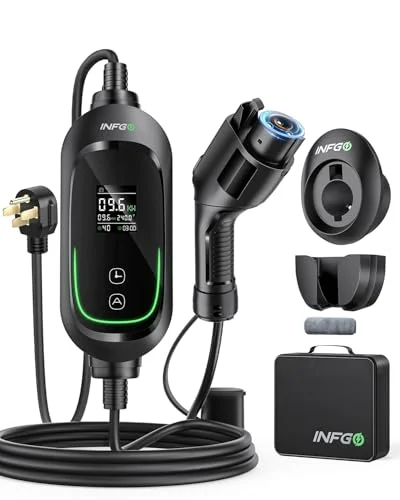
Both outlets are 50 A at 240 V and both let a 40 A charger draw its full 9.6 kW. The 14-50 has a neutral pin; the 6-50 does not. An EV charger uses no neutral, so for charging the two are equivalent, and whichever is already on your wall decides.
That is the answer most comparisons bury under a specification table. What follows is the table anyway, plus the three cases where the choice does matter.
The two outlets, side by side
| NEMA 14-50 | NEMA 6-50 | |
|---|---|---|
| Slots | 4 | 3 |
| Conductors | Two hot, neutral, ground | Two hot, ground |
| Voltage | 125 / 250 V | 250 V |
| Rated current | 50 A | 50 A |
| Continuous EV load allowed | 40 A | 40 A |
| Power to a 40 A charger | 9.6 kW | 9.6 kW |
| Common existing use | RV hookups, electric ranges | Welders, plasma cutters |
| Can supply 120 V | Yes, via the neutral | No |
| Cable | Four conductors | Three conductors |
Read the “power to a 40 A charger” row twice, because it is the one that settles the question people are usually asking. The neutral carries no charging current. A Level 2 charger sits across the two hot legs at 240 V and that is all it touches.
Why 50 A gives you 40 A and not 50
The National Electrical Code treats EV charging as a continuous load, which means the branch circuit is rated at 125 percent of the current the equipment actually draws. Run that backwards and a 50 A circuit supports 40 A of continuous draw, because 40 times 1.25 is 50.
This is not a rule of thumb. It reproduces the manufacturer’s own specification exactly: INFGO states a 50 A breaker with 8 AWG cable for its 40 A chargers, which is what the 125 percent rule gives. The same rule applied to the charger’s lower settings:
| Charger setting | Power | Minimum circuit | Breaker | Range added per hour |
|---|---|---|---|---|
| 40 A | 9.60 kW | 50 A | 50 A | 22 to 34 miles |
| 32 A | 7.68 kW | 40 A | 40 A | 18 to 27 miles |
| 24 A | 5.76 kW | 30 A | 30 A | 13 to 20 miles |
| 16 A | 3.84 kW | 20 A | 20 A | 9 to 13 miles |
| 8 A | 1.92 kW | 10 A | 15 A | 4 to 7 miles |
Range figures use 2.3 to 3.5 miles per kilowatt-hour, the band that reproduces INFGO’s own published 9 to 13 miles per hour at 3.84 kW and 3 to 5 at 1.44 kW. Conductor sizes depend on insulation rating, run length and local amendments, so treat the breaker column as a sanity check and let a licensed electrician size the cable.
The three cases where the choice actually matters
You already have one of them. This decides it more often than anything else. An RV outlet or an old range outlet in the garage is almost certainly a 14-50. A welder outlet is almost certainly a 6-50. Reusing an existing circuit is the difference between an afternoon and a wiring job, so start by opening the cover plate and counting slots. If a new one is going in, an EV-rated 14-50 receptacle is built for the continuous load a charger puts on it, which a cheap range outlet is not.
You want the circuit to do more than charge. A 14-50 with its neutral will run an RV, a range, a 120 V tool through an adapter. A 6-50 will run 240 V equipment and nothing else. If the garage might host a camper or a workshop, the neutral is worth the fourth conductor.
The run is long or difficult. Four conductors of 6 or 8 AWG through finished walls cost more than three and are harder to pull. On a short, exposed run the difference is small; on a fifty-foot fish through insulation it is not.
What each outlet can also run
| NEMA 14-50 | NEMA 6-50 | |
|---|---|---|
| Level 2 EV charger | Yes | Yes |
| RV, 30 A or 50 A service | Yes | No, needs the neutral |
| Electric range or oven | Yes | No |
| Stick or MIG welder | Yes | Yes |
| Plasma cutter, 240 V | Yes | Yes |
| Shop vac or 120 V tool through an adapter | Yes | No |
The adapter trap
INFGO’s 40 A chargers, both the J1772 and the NACS version — a choice covered in J1772 vs NACS — come with a NEMA 14-50 plug, which is the plug most Level 2 chargers ship with. If your garage has a 6-50, the tempting fix is a 6-50-to-14-50 adapter.
Electrically the charging works, because the neutral pin on the charger’s plug is doing nothing anyway. The problems are practical. A listed adapter in that direction is hard to find, most of what is sold is unlisted, and an adapter adds two more connections to a joint carrying 40 A continuously for hours at a time. Heat builds at loose connections, not in the middle of a cable.
Two clean answers instead:
- Fit a 14-50 receptacle, if the existing run has a neutral in it. Many do not, and pulling one usually means a new cable, which is the expensive half of the job.
- Match the charger to the outlet. A charger sold with a 6-50 plug, or hardwired, needs no adapter at all.
There is a third option worth knowing about: if the circuit you can reach is smaller than 50 A, a charger with an adjustable current limit lets you use it properly. INFGO’s 40 A models step down to 32, 24, 20, 16, 12 and 8 A, so a 30 A circuit runs the charger at 24 A and 5.76 kW rather than not at all. For a car that sits overnight, 13 to 20 miles an hour over ten hours is more range than most people drive in a day.
Which to install if you are starting from nothing
Install a 14-50. Not because it charges faster, because it does not, but because it costs a little more once and keeps the circuit useful for everything else a garage ends up doing. It is also the plug that comes on the majority of Level 2 chargers, including both of INFGO’s, which means fewer adapters over the life of the outlet.
Choose the 6-50 when the run is genuinely awkward, when the circuit will only ever charge a car, and when you are buying a charger with a matching plug. It is not a worse outlet. It is a narrower one.
One more thing to raise with the electrician rather than decide yourself: recent code cycles require GFCI protection for 240 V receptacles in garages, and EV chargers with their own leakage protection built in have a history of nuisance-tripping GFCI breakers. INFGO states that its 40 A chargers include CCID20 leakage protection and that no separate GFCI breaker is required, but which protection your local inspector wants on a receptacle circuit is their call, not the manufacturer’s. Hardwiring the charger removes the receptacle from the question entirely.
Frequently Asked Questions
Is a NEMA 14-50 better than a 6-50 for EV charging?
Not for charging speed. Both are 50 A, 240 V circuits, and both let a 40 A charger run at its full 9.6 kW. The 14-50 is more versatile because its neutral lets the same outlet run 120 V loads, which is what an RV or a range needs. The 6-50 is simpler and cheaper to install because it carries one conductor fewer.
Does an EV charger need a neutral?
No. A Level 2 EV charger is a straight 240 V load across the two hot legs, so it uses no neutral at all. That is why a 6-50 outlet charges a car perfectly well, and why the neutral pin on a 14-50 plug does nothing while the car is charging. The neutral only matters for what else you might plug into that circuit.
Can I use a 6-50 to 14-50 adapter?
Electrically the 240 V charging works, because the charger never uses the neutral. The problem is that the adapter leaves the plug's neutral pin unconnected, and a listed adapter for that direction is hard to find. The clean answers are to fit a receptacle that matches your charger's plug, or to run the circuit to a charger sold with the plug you already have.
How many amps can I actually draw from a 50 A outlet?
Forty. An EV charger is a continuous load, so the code rates the circuit at 125 percent of the draw: 40 A times 1.25 is 50 A. That is why 40 A chargers and 50 A circuits go together, and it is exactly the 50 A breaker INFGO specifies for its own 40 A models.
Which outlet is cheaper to install?
The 6-50, marginally. It needs three conductors instead of four, so the cable is smaller and slightly cheaper, and there is one fewer termination at each end. On a short run in an accessible garage the difference is small enough that many electricians quote the two the same; on a long run through finished walls the saving is more visible.
I already have a dryer outlet in the garage. Can I use that?
A dryer outlet is usually a NEMA 14-30, which is a 30 A circuit, not 50 A. That caps a charger at 24 A continuous, or 5.76 kW, which still adds 13 to 20 miles of range an hour. It is a real option, but it is a different outlet from both of the ones compared here and needs a charger set to 24 A or below.
A 14-50 charger that also runs on smaller circuits
INFGO's 40 A Level 2 charger plugs into a NEMA 14-50 outlet and adjusts from 8 A to 40 A, so the same unit works on a 50 A circuit at full 9.6 kW or on a smaller one at a lower setting.
See the 40 A charger