J1772 vs NACS: What Each Connector Is, and What Changes at Home
Published
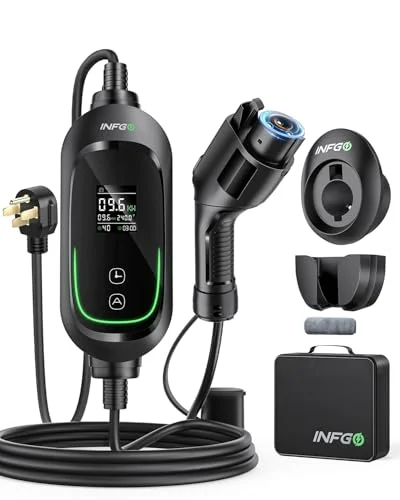
J1772 is the AC connector on non-Tesla EVs. NACS is Tesla’s, standardised as SAE J3400 and now factory-fitted by most brands. Neither is faster at home: a 40 A charger delivers 9.6 kW through either. The connector decides one thing, whether you need an adapter.
That is the short answer, and it contradicts how the choice is usually presented. Almost every comparison of these two connectors is written about public fast charging, where the difference is real and large. In a garage it collapses to a question about plug shapes.
The two connectors, pin for pin
| J1772 | NACS | |
|---|---|---|
| Standards number | SAE J1772 | SAE J3400 |
| Standardised | 2001, revised since | Technical Information Report December 2023; Recommended Practice September 2024 |
| Pins | 5 | 5 |
| What the pins do | Two AC power, ground, control pilot, proximity pilot | Two power pins that carry AC or DC, ground, two communication |
| AC charging | Yes | Yes |
| DC fast charging | No, not on its own | Yes, on the same two power pins |
| How it fast charges | CCS1 adds two DC pins in a second housing below the J1772 head | It does not need a second housing |
| DC rating | Up to 500 A / 1000 V through CCS1 | 500 A / 1000 V |
| Fitted to | Effectively every non-Tesla EV sold in North America up to model year 2025 | Every Tesla, plus factory ports on most brands from model year 2025 |
The pin count is the same, and that is what makes NACS the neater engineering: it moves DC onto the pins that already carry AC, so one small connector does both jobs. J1772 keeps AC and DC separate, which is why a CCS1 inlet is the large two-part shape you see on a Ford or a Hyundai. Physically bigger, functionally identical at a wall outlet.
Why the connector cannot change your home charging speed
Home charging speed is arithmetic, not connector design. Power is volts times amps, and every Level 2 charger in North America works at the same 240 V. What differs is the current, which is set by the circuit and the charger’s own limit.
| Current setting | Power | Range added per hour | Minimum circuit (125%) | Breaker |
|---|---|---|---|---|
| 8 A | 1.92 kW | 4 to 7 miles | 10 A | 15 A |
| 12 A | 2.88 kW | 7 to 10 miles | 15 A | 15 A |
| 16 A | 3.84 kW | 9 to 13 miles | 20 A | 20 A |
| 20 A | 4.80 kW | 11 to 17 miles | 25 A | 25 A |
| 24 A | 5.76 kW | 13 to 20 miles | 30 A | 30 A |
| 32 A | 7.68 kW | 18 to 27 miles | 40 A | 40 A |
| 40 A | 9.60 kW | 22 to 34 miles | 50 A | 50 A |
Two things are worth saying about that table, because most versions of it online say neither.
The range figures assume a car travels 2.3 to 3.5 miles on a kilowatt-hour. That band is not a guess we made: it is the one that reproduces INFGO’s own published figures of 9 to 13 miles per hour at 3.84 kW and 3 to 5 at 1.44 kW. A heavy, inefficient EV sits at the bottom of each range and a small efficient one at the top.
The breaker column applies the rule the National Electrical Code uses for continuous loads: the circuit is rated at 125 percent of the draw. At 40 A that gives 50 A, which is exactly the breaker INFGO specifies for its 40 A chargers. The rule reproduces the manufacturer’s own requirement, which is why it is safe to extend it to the lower settings.
Nowhere in that arithmetic does the connector appear. A 9.6 kW charger is a 9.6 kW charger.
What the connector actually decides
Adapters. That is the whole of it, and it runs in both directions.
A J1772 charger and a Tesla. Every Tesla ships with a J1772-to-NACS adapter. Plug it on, charge at full rate. This is the most common combination in North American garages and it works without buying anything, though a spare UL-listed adapter is worth keeping if the original went missing with a used car.
A NACS charger and a non-Tesla car. This needs a NACS-to-J1772 adapter, which is a less common accessory than the Tesla one. If the household has a Ford, a Hyundai or a Kia with a CCS1 inlet, a NACS home charger is the awkward choice.
A NACS charger and a factory-NACS car. Nothing to carry, nothing to lose, nothing to leave in the other car. This is the case where a NACS charger earns its place.
A J1772 charger and a factory-NACS car. Works with the adapter the car came with. Slightly less convenient every night, entirely functional.
From model year 2025 onward, Ford, GM, Rivian, Hyundai, Kia, Genesis, Volvo, Polestar, BMW, Toyota, Lexus, Subaru and the Volkswagen Group all began shipping cars with NACS ports fitted at the factory, and the rest are following. That transition changes which adapter sits in your glovebox. It does not change the wiring in your garage.
Which charger for which car
INFGO builds the same 40 A body in both connectors, which is what makes the comparison clean: identical 9.6 kW output, identical 25 ft cable, identical NEMA 14-50 plug, identical 8 A to 40 A adjustment and 0.5 to 12 hour delayed start. The only difference is what is on the end of the cable.
| Your car | Charger | Adapter needed |
|---|---|---|
| Ford, GM, Hyundai, Kia, Rivian with a CCS1 inlet | J1772 Level 2, 40 A | None |
| Tesla, and only Tesla, now and later | NACS Level 2, 40 A | None |
| A Tesla now, a non-Tesla possible later | J1772 Level 2, 40 A | The J1772 adapter the Tesla came with |
| A 2025-or-later car with a factory NACS port | Either | The J1772 adapter the car came with, if you choose J1772 |
| Two cars, one of each | J1772 Level 2, 40 A | The Tesla’s own adapter for the Tesla |
One caveat on the J1772 model that its own listing states plainly: INFGO excludes the Toyota Prius and RAV4. Every other J1772 electric and plug-in hybrid plugs straight in.
If you want a charger that travels rather than one that hangs on a wall, INFGO’s Level 1 and 2 NACS charger ships with both a NEMA 6-20 plug for a 240 V circuit and a NEMA 5-15 adapter for an ordinary household outlet. It is slower by design, 3.84 kW rather than 9.6, but it fits in a frunk.
The one place the difference is real
Public DC fast charging. A NACS car can pull up to a Tesla Supercharger and plug in. A CCS1 car needs either a Magic Dock station or a NACS-to-CCS adapter, and that only works on V3 and V4 Superchargers, not V1 or V2, because the older stations do not speak the protocol.
That is a road-trip question, not a garage question. It is also the reason the two connectors get compared so often in terms that have nothing to do with the charger you bolt to your own wall.
So which one to buy
Buy for the connector on the car you own, and let the adapter handle the exception. If the household has any non-Tesla EV, buy J1772: it covers that car directly and the Tesla through an adapter it already owns. If every car in the household is a Tesla and will stay one, buy NACS and skip the adapter.
Buy for the circuit, not the connector, in every other respect. A 50 A circuit lets a 40 A charger run at 9.6 kW; a 20 A circuit caps you at 3.84 kW no matter which plug you chose. That is the decision that changes how fast you charge.
Frequently Asked Questions
Is NACS better than J1772?
Not for home charging. Both carry the same AC power, so a 40 A charger delivers 9.6 kW through either connector. NACS is the more capable connector in one respect: it handles DC fast charging on the same two pins, while a J1772 head needs the two extra DC pins of CCS1 below it to fast charge. At a 240 V outlet in your garage, that difference never comes into play.
Can I use a J1772 charger on a Tesla?
Yes, with a J1772-to-NACS adapter, which every Tesla ships with. The charger sees a standard AC load and the car charges at its usual rate. The reverse is not true in general: a NACS charger will not plug into a J1772 inlet without a NACS-to-J1772 adapter, and those are less common than the Tesla adapter that goes the other way.
Do I need a NACS charger if my next car has a NACS port?
No, if you already own a J1772 charger and the car comes with the adapter, which factory NACS cars generally do. Buy the NACS charger when you want to plug in without handling an adapter every night, or when the car is a Tesla and always will be. Buy the J1772 charger when the household has, or may have, a non-Tesla EV.
What is SAE J3400?
It is the standards number for NACS. SAE International published NACS as a Technical Information Report in December 2023 and raised it to a Recommended Practice in September 2024, which is what turned Tesla's connector into an industry standard other manufacturers could design against. The connector is rated to 1000 V and 500 A DC.
Does a NACS connector charge faster at home than J1772?
No. Home charging speed is set by the circuit, not the connector: amps times volts. At 240 V, 40 A is 9.6 kW whichever plug is on the end of the cable. A 32 A charger on a 40 A breaker gives 7.68 kW, and a 16 A charger gives 3.84 kW, again regardless of connector.
Will J1772 chargers become obsolete?
Not soon. Millions of J1772 inlets are already on the road, public Level 2 charging is overwhelmingly J1772, and NACS cars can use J1772 stations with the adapter they ship with. A J1772 home charger stays useful for as long as any J1772 car is in the household, and it serves NACS cars through an adapter in the meantime.
The J1772 version of the same 40 A body
INFGO's Level 2 charger: 40 A and 9.6 kW at 240 V, current selectable from 8 A, a 25 ft cable and a NEMA 14-50 plug, so it fits any J1772 electric or plug-in hybrid vehicle without an adapter.
See the J1772 charger