How to Connect a Generator to Your House: The Three Legal Ways
Published
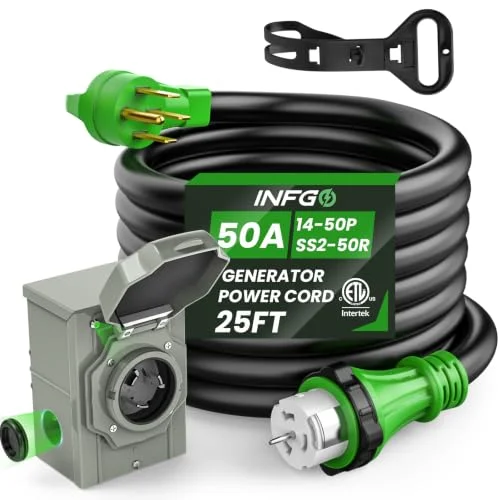
Three legal ways: extension cords straight to appliances, an inlet box plus a panel interlock, or an inlet box plus a transfer switch. The last two need a cord sized to the generator’s outlet, either a 30 A L14-30 set or a 50 A 14-50 set, and an electrician at the panel end. A fourth way, the double-ended cord, kills people.
The three routes, and the one that is not a route
| Extension cords | Inlet box + interlock | Inlet box + transfer switch | Double-ended cord | |
|---|---|---|---|---|
| Connects to house wiring | No | Yes | Yes | Yes, dangerously |
| Transfer equipment required | None | The interlock | The switch | None used |
| House outlets and lights work | No | Yes | On the switched circuits | Yes |
| Hard-wired loads work | No | Yes | If wired in | Yes |
| Electrician needed | No | Yes | Yes | — |
| Legal | Yes | Yes, with a listed kit | Yes | No |
| Failure mode | Tripping over cords | None if installed correctly | None if installed correctly | Exposed live pins; energises the utility line |
The cord route is genuinely fine for a fridge and a couple of lamps, and it needs nothing on this page. Everything below is about the two routes that make the house’s own wiring work.
The fourth column exists because it keeps being suggested. A cord with a male plug on both ends is live at one end whenever the other is plugged in, and back-feeding through a dryer outlet bypasses any mechanism that keeps the generator off the utility supply. That is how a home generator ends up energising the service drop and killing a lineworker who had every reason to believe the line was dead.
What the proper installation is made of
Four parts, in the order the power flows.
1. The generator, outdoors, at least 20 feet from the house per CPSC guidance, exhaust directed away from the building.
2. The cord, from the generator’s 240 V outlet to the wall. Sized by the connector on the generator.
3. The power inlet box, mounted on an exterior wall. Its pins are recessed and only become live when the cord is seated in it, which is the whole safety difference between an inlet box and a receptacle.
4. Transfer equipment, inside: either an interlock plate matched to your panel brand and amperage, or a separate transfer switch. This is what guarantees the utility supply and the generator can never be connected at the same time.
Parts 2 and 3 are what INFGO sells as a matched kit, which removes the most common ordering mistake in the category: a cord whose female end does not fit the box you bought.
Sizing the cord and box
By the connector on the generator. Not by its wattage badge, not by the size of your panel.
| Generator outlet | Kit | Cord | Inlet box | Rating | Ceiling | Conductors |
|---|---|---|---|---|---|---|
| NEMA L14-30R | 30 A kit | L14-30P to L14-30R | L14-30P | 30 A at 250 V | 7,500 W | 10/4 AWG copper |
| NEMA 14-50R | 50 A kit | 14-50P to SS2-50R | SS2-50P | 50 A at 250 V | 12,500 W | One 6 AWG plus three 8 AWG copper |
The wattage figures are the arithmetic, not a claim: 30 A times 250 V is 7,500 W, and 50 A times 250 V is 12,500 W, which is what both listings state. Read them as ceilings. The cord passes whatever the generator actually produces, and a 5,000 W generator on a 7,500 W cord delivers 5,000 W.
The 10/4 AWG on the 30 A cord is worth a note, because it is the answer people arrive at independently. Ask how to do this on any homeowner forum and you will get some version of “power inlet plus an interlock, and use 10 gauge wire.” Four conductors of 10 AWG is what a 30 A, 125/250 V circuit takes: two hot legs, a neutral and a ground. That is the specification, described by a stranger who has done it.
The order of operations
The sequence matters, and your electrician will normally label it on the panel door. It runs like this.
- Turn the main breaker off. On an interlock, this is also what frees the plate to move.
- Position the generator outdoors, 20 feet or more from the house, exhaust away from the building, windows and doors.
- Connect the cord with the generator not running: into the generator first, then into the inlet box. Seat the twist-lock connector fully and turn it to lock.
- Start the generator and let it stabilise before it takes any load.
- Switch over: slide the interlock plate and close the generator breaker, or throw the transfer switch.
- Bring loads on a few at a time, largest first, watching the generator.
Shutting down runs the same list backwards: loads off, generator breaker off, generator off, cord out of the box, cord out of the generator, main breaker back on.
Managing the load, because the generator is the real limit
The cord’s rating is a ceiling; the generator’s running output is the constraint. On an interlock installation every circuit in the panel is available, which is the interlock’s advantage and also the thing that requires discipline: you decide what runs by which breakers you leave on.
Two habits make that manageable. Start the largest motor load — a well pump, a furnace blower, a fridge compressor — first and alone, because motors draw several times their running current for the first second or two. Then add the small steady loads. And leave anything with a heating element out of the plan unless the generator is genuinely large: electric water heaters, ranges and clothes dryers are the loads that overwhelm a portable generator.
A transfer switch takes that decision out of your hands by only feeding the circuits wired into it, which some people prefer precisely because it cannot be got wrong at two in the morning.
The safety points that are not about electricity
Carbon monoxide is what actually kills people during outages, at an estimated 85 deaths a year in the United States from portable generators alone. The rules are short and there is no version of them that involves a garage.
- Outdoors only, at least 20 feet from the house, exhaust pointed away from the building.
- Never in a garage, basement, crawlspace, shed or on a porch. Opening the door does not make it safe.
- Working CO alarms inside the house, on every level.
- Refuel with the engine off and cool. Petrol on a hot exhaust manifold is the other way a generator starts a fire.
- Keep the cord out of standing water and off paths where it will be walked on, and let the moulded plugs and the STW jacket do the weather protection they were rated for.
What to buy, and what to hand over
Buy the cord and inlet box as a matched set sized to your generator’s outlet: the 30 A kit for an L14-30R generator, the 50 A kit for a 14-50R one. Both are ETL listed on the cord and the box, with the box pre-drilled on all four sides so the cable can enter from whichever direction the wall allows, and a green indicator that shows when power is present at the box.
Choose the cord length from where the generator will actually stand, and remember the 20-foot minimum is a floor, not a target: 25 ft is the general-case length, 50 ft if the generator has to sit around a corner or well clear of windows.
Hand the panel end to a licensed electrician: the interlock or transfer switch, the generator breaker, the feed from the inlet box, and the inspection. The reasoning on this page is not complicated, but the consequence of getting it wrong lands on someone who never agreed to the risk.
For the choice between an interlock and a transfer switch, and what each one costs you in available circuits, see generator interlock vs transfer switch.
Frequently Asked Questions
Can I connect a generator to my house without a transfer switch?
Yes, with a panel interlock instead. An interlock kit is a plate that makes it mechanically impossible to have the main breaker and the generator breaker on at the same time, and code accepts it as transfer equipment when it is listed for your exact panel model and installed to that listing. What you cannot legally or safely do is connect without either one.
What do I need to hook up a portable generator to my house?
Four things: a power inlet box on an exterior wall, a cord that matches the generator's outlet, either a panel interlock or a transfer switch, and a licensed electrician for the panel end. The inlet box and cord are the parts you buy as a set; the interlock or switch is chosen to fit your panel; the wiring between them is the electrician's work.
Is it illegal to backfeed a generator into a dryer outlet?
It violates the code requirement that utility and generator can never be connected at once, and the double-ended cord it needs leaves live exposed pins whenever one end is out. It can also energise the utility line outside your house. Every jurisdiction treats it as unsafe, and it is the method behind lineworker deaths after storms.
How far does a generator need to be from the house?
The CPSC's guidance is outdoors only, at least 20 feet from the house, with the exhaust pointed away from the building and away from windows and doors. Carbon monoxide from portable generators kills an estimated 85 people a year in the United States. That 20-foot minimum is why a 25 ft cord is the practical starting length rather than a 10 or 15 ft one.
What size cord do I need for my generator?
The connector on the generator decides it. A NEMA L14-30R outlet takes a 30 A cord with an L14-30P plug, rated 7,500 W, in 10/4 AWG. A NEMA 14-50R outlet takes a 50 A cord with a 14-50P plug, rated 12,500 W, in heavier conductors. Never adapt between the two families: that would let a 50 A source feed a 30 A cord.
Can I install the inlet box myself and have an electrician do the rest?
Ask the electrician first, because in many jurisdictions the whole installation is inspected as one job and they will want to site the box themselves. Where the box needs to go depends on the panel's position, the cable route and the clearances your inspector wants around windows and doors, and those are decisions the person signing off the work should make.
Match the kit to the generator's outlet
INFGO's 50 A kit is for a generator with a NEMA 14-50R outlet: an ETL-listed 14-50P to SS2-50R cord rated 12,500 W, with a pre-drilled SS2-50P inlet box. For an L14-30R generator, the 30 A kit is the matching set.
See the 50 A cord and inlet kit