How Long Does It Take to Charge an EV? One Formula and Three Ceilings
Published
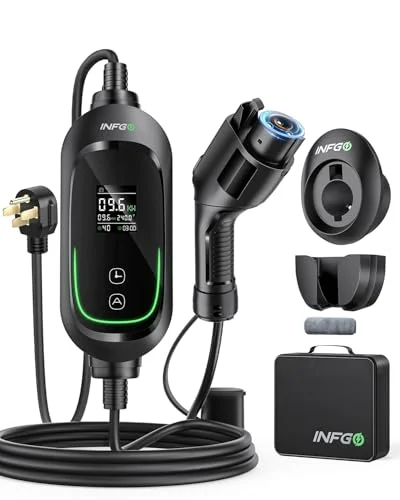
Charging time is one division: battery kilowatt-hours divided by charging kilowatts, then about ten percent longer for the loss in converting AC to DC. A 75 kWh battery on a 9.6 kW home charger fills in roughly 8.7 hours. Everything else is which number goes in the denominator.
Most answers to this question give a range so wide it is useless — “four to forty hours” — because they average over three different kinds of charging. Splitting them apart makes the arithmetic simple again.
The formula, and where the ten percent goes
Power in kilowatts is volts times amps, divided by a thousand. Forty amps at 240 V is 9.6 kW. Twelve amps at 120 V is 1.44 kW. That is the number your charger delivers.
Not all of it reaches the battery. The car’s onboard charger converts AC to DC and loses some of it as heat, and the battery loses a little more. Around ninety percent arriving at the pack is a reasonable working figure for Level 2 charging, so the honest formula is:
hours = battery kWh ÷ (charging kW × 0.9)
Empty to full, by power level
| Battery | 1.44 kW (120 V, 12 A) | 3.84 kW (240 V, 16 A) | 7.68 kW (240 V, 32 A) | 9.60 kW (240 V, 40 A) |
|---|---|---|---|---|
| 50 kWh | 38.6 h | 14.5 h | 7.2 h | 5.8 h |
| 60 kWh | 46.3 h | 17.4 h | 8.7 h | 6.9 h |
| 75 kWh | 57.9 h | 21.7 h | 10.9 h | 8.7 h |
| 90 kWh | 69.4 h | 26.0 h | 13.0 h | 10.4 h |
| 100 kWh | 77.2 h | 28.9 h | 14.5 h | 11.6 h |
Twenty to eighty percent, which is what people actually do
Nobody runs an EV to zero and then fills it. The everyday cycle is a partial top-up, and 60 percent of the pack is a realistic slice.
| Battery | 1.44 kW | 3.84 kW | 7.68 kW | 9.60 kW |
|---|---|---|---|---|
| 50 kWh | 23.1 h | 8.7 h | 4.3 h | 3.5 h |
| 60 kWh | 27.8 h | 10.4 h | 5.2 h | 4.2 h |
| 75 kWh | 34.7 h | 13.0 h | 6.5 h | 5.2 h |
| 90 kWh | 41.7 h | 15.6 h | 7.8 h | 6.2 h |
| 100 kWh | 46.3 h | 17.4 h | 8.7 h | 6.9 h |
At 9.6 kW every pack size in that table finishes inside a single night. At 1.44 kW none of them does, which is the whole case for a 240 V circuit.
Range added per hour, which is the number that matters overnight
Hours-to-full is the wrong frame for a car that sleeps at home. The right one is how much range appears while it is plugged in.
| Charger draw | Range added per hour | 8 hours plugged in | 12 hours plugged in |
|---|---|---|---|
| 1.44 kW | 3 to 5 miles | 26 to 40 miles | 40 to 60 miles |
| 3.84 kW | 9 to 13 miles | 71 to 108 miles | 106 to 161 miles |
| 7.68 kW | 18 to 27 miles | 141 to 215 miles | 212 to 323 miles |
| 9.60 kW | 22 to 34 miles | 177 to 269 miles | 265 to 403 miles |
These figures use 2.3 to 3.5 miles per kilowatt-hour, and there is a reason to trust that band rather than take it on faith: it is the band that reproduces INFGO’s own published figures of 9 to 13 miles per hour at 3.84 kW and 3 to 5 at 1.44 kW, both of which appear in the table above. Because those published figures are measured per hour of charging at the plug, the band already absorbs the conversion loss. Do not apply the ten percent twice.
The practical reading of that table: at 9.6 kW an eight-hour night covers more than a week of average American driving. Most households do not need a faster charger. They need a 240 V circuit.
The three ceilings
Charging speed is the lowest of three limits, and the one people forget is the third.
The circuit. A continuous load is rated at 125 percent of the draw, so a 50 A breaker supports 40 A and 9.6 kW; a 30 A breaker supports 24 A and 5.76 kW. This is not a rule of thumb: the 125 percent rule applied to 40 A gives the 50 A breaker and 8 AWG cable INFGO specifies for its own 40 A charger. Which 50 A outlet to install is a separate question, answered in NEMA 14-50 vs 6-50.
The charger. Its maximum, and on an adjustable unit whatever setting you left it on. INFGO’s 40 A models step through 8, 12, 16, 20, 24, 32 and 40 A, which exists so a charger can match a smaller circuit rather than trip it.
The car’s onboard charger. This is the ceiling that surprises people. Every EV converts AC to DC on board, and that converter has its own rating.
| The car’s AC limit | Amps at 240 V | Range added per hour | What a 9.6 kW charger gives it |
|---|---|---|---|
| 3.6 kW | 15 A | 8 to 13 miles | 3.6 kW |
| 6.6 kW | 27.5 A | 15 to 23 miles | 6.6 kW |
| 7.7 kW | 32 A | 18 to 27 miles | 7.7 kW |
| 9.6 kW | 40 A | 22 to 34 miles | 9.6 kW |
| 11.5 kW | 48 A | 26 to 40 miles | 9.6 kW |
A car capped at 7.7 kW charges at 7.7 kW from a 9.6 kW charger, an 11 kW charger and a 19 kW charger alike. Before paying for more amps, check the car’s stated maximum AC charging rate. It is the cheapest specification to look up and the one most often skipped.
DC fast charging is a different mechanism
Level 1 and Level 2 send AC to the car and let the car convert it. DC fast charging bypasses the onboard charger entirely and feeds the battery directly, which is why it is measured in tens of minutes rather than hours.
| Battery | 10 to 80 percent | At 50 kW | At 150 kW | At 250 kW |
|---|---|---|---|---|
| 60 kWh | 42 kWh | 50 min | 17 min | 10 min |
| 75 kWh | 52 kWh | 63 min | 21 min | 13 min |
| 100 kWh | 70 kWh | 84 min | 28 min | 17 min |
Treat those as floors, not forecasts. DC power tapers as the battery fills — steeply above about 80 percent, which is why the 10-to-80 window is the one everyone quotes — and the station, the cable and the car each impose their own limit. A NACS-to-CCS adapter opens Tesla V3 and V4 Superchargers to a CCS1 car — why V1 and V2 stay closed is a protocol story, not a connector one — and there the station’s peak and the car’s acceptance rate decide between them which of those columns you get.
Putting it together
For a household with a car that sleeps at home, the sequence is: find the car’s AC limit, find the biggest circuit you can reasonably run, and buy a charger that covers both. That usually lands on 40 A and a 50 A circuit, which is INFGO’s 40 A Level 2 charger in J1772 or the NACS version for a Tesla.
If a 240 V circuit is genuinely out of reach, a portable Level 1 and 2 charger covers both cases: 1.44 kW from an ordinary outlet, 3.84 kW when you find a 240 V one. Three to five miles an hour is not a charge, but over a weekend it is a hundred miles, and it fits in the boot.
Have any new circuit installed by a licensed electrician to your local code. The arithmetic on this page sizes the equipment; it does not size the wire.
Frequently Asked Questions
How long does it take to charge an EV at home?
On a 240 V Level 2 charger at 9.6 kW, a 75 kWh battery goes from empty to full in about 8.7 hours, allowing for conversion loss. From 20 to 80 percent, the range most people actually use, it is about 5.2 hours. On a 120 V household outlet at 1.44 kW the same empty-to-full charge takes nearly 58 hours, which is why Level 1 is a top-up rather than a charge.
How many miles of range does an hour of charging add?
At 9.6 kW, 22 to 34 miles. At 7.68 kW, 18 to 27. At 3.84 kW, 9 to 13, which is exactly what INFGO publishes for its 3.84 kW charger. At 1.44 kW on a household outlet, 3 to 5. The spread inside each range is the difference between a heavy inefficient EV and a small efficient one.
Why is my EV charging slower than the charger's rating?
Almost always the car's onboard charger, which converts AC to DC and has its own limit. A car capped at 7.7 kW draws 7.7 kW from an 11 kW charger and no more. The other two ceilings are the circuit, which caps the charger, and a battery-management taper near full. Check the car's specification for its maximum AC charging rate before blaming the hardware.
Does charging to 100 percent take longer per percent than charging to 80?
On DC fast charging, dramatically. Power tapers as the battery fills, so the last 20 percent can take as long as the first 60. On AC Level 2 charging the taper is much gentler because the rate is already far below what the battery could accept, which is one practical argument for doing the full charge at home and the 10-to-80 stop on the road.
How long does a DC fast charge take?
For a 75 kWh battery from 10 to 80 percent: about 13 minutes at a sustained 250 kW, 21 minutes at 150 kW, and 63 minutes at 50 kW. Those are arithmetic floors. Real sessions run longer because power tapers, and because the station's peak, the cable and the car's own acceptance rate rarely all line up at once.
Is it cheaper to charge overnight?
Where your utility has time-of-use rates, yes, and the saving is the reason delayed-start timers exist. INFGO's Level 2 chargers can be set to begin between 0.5 and 12 hours after you plug in, so the car sits on the cable at dinner time and starts drawing when the off-peak window opens.
The charger that fills the tables above
INFGO's 40 A Level 2 charger delivers 9.6 kW at 240 V, adjusts down to 8 A for smaller circuits, and can delay its start by up to 12 hours to catch off-peak rates. NEMA 14-50 plug, 25 ft cable.
See the 40 A charger